
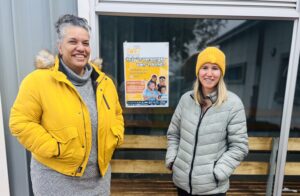
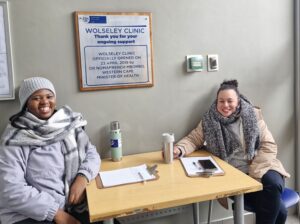
The SWIFT study recently ran a pilot at a clinic in Wolseley, a small rural town in the Western Cape. Initially, uptake was low with only 20 participants joining the ParentText programme in the first week. However, our team’s willingness to adapt quickly turned things around. Working collaboratively with clinic staff and patients, we implemented several rapid changes: redesigning recruitment posters to be more visual and less text-heavy, involving pharmacists and other clinic staff (beyond nurses) in promoting the programme, shortening the encouragement script to under 10 seconds per patient, and designing small handheld flyers for busy staff members. Within one week, participation jumped to 175 users – demonstrating the success of the changes we made. These changes were only possible through the real-time collaborative problem-solving, which we were able to do as a result of the strong relationships we built during formative stakeholder engagements.
 One week after the pilot closed, an unexpected surge occurred overnight: the programme skyrocketed from 175 to 18 229 users! After immediately shutting down the chatbot and reporting to the appropriate ethics committee, our technical team confirmed these were genuine South African users. Some further digging revealed that the R25 mobile data reimbursement for completing a survey (which we’d deliberately not advertised on any recruitment materials) had gone viral on social media, spreading through Facebook groups with hundreds of thousands of members.
Realising quickly that the power of social media cannot be underestimated or ignored, we embraced the opportunity. We designed shareable social media tiles for participant-driven recruitment and adjusted the incentive structure to provide data reimbursement only for 3-month follow-up surveys after the chatbot is closed to new users joining. We’ve also since adopted a new study design (a time series trial), which will allow us to more clearly understand the impact of encouragement on programme initiation and engagement. Most encouragingly, despite many users likely joining for the incentive, 1,911 caregivers who had joined during the surge completed the entire first 5-day module, suggesting that it was the programme itself that retained nearly 2000 people.
 Key takeaways:
- Stay flexible! Be willing to adapt your methods when evidence suggests improvements are needed and do not be too attached to your original plan.
- Be present in the field – being on-site where possible allows you to learn iteratively & test solutions collaboratively in real time.
- Engage stakeholders meaningfully and tap into their expertise both before and during the study, regularly keeping them informed of updates and changes.
- Recognise the power of even small incentives if you are working in under-resourced contexts.
- Expect the unexpected in digital spaces: technical platforms and online behaviour can create scenarios you have not planned for.
- Lean into the potential for social media and incorporate it into your study and intervention designs.