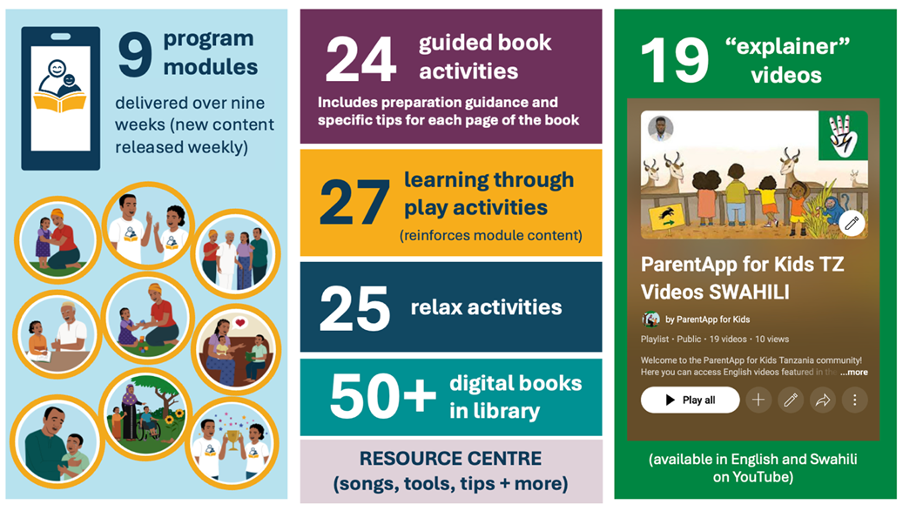
ParentApp for Kids is a digital and blended parenting programme implemented and evaluated in Tanzania that aims to strengthen responsive caregiving, opportunities for early learning, and prevention of violence against children. The project adapts Parenting for Lifelong Health for Young Children into an app for caregivers of roughly 4-6-year-olds, and assesses its feasibility, acceptability, and preliminary effectiveness through a randomised controlled trial comparing a fully digital app with a blended model (app plus WhatsApp and in-person sessions).
A key feature of the ParentApp for Kids intervention is support for caregivers to engage their children in picture book-based shared reading activities. The app includes a variety of guided book activities and a library of over 50 digital picture books for that caregivers can use for shared reading activities.
Podcast with Dr. Joyce Wamoyi
Africa Rights Talk | S7 E6: Ending Sexual Abuse Against Children
3 July 2025
Dr. Joyce Wamoyi recently joined Seán Coughlan, Director of To Zero, on the Africa Rights Talk podcast to explore practical strategies for ending childhood sexual violence across the continent.
The conversation spotlighted A Vision to Zero, a global roadmap developed by more than 50 organisations and 330 field leaders, which outlines coordinated, evidence-based actions to prevent sexual violence against children.
Dr. Wamoyi also shared insights from Tanzania’s ParentApp Teen digital parenting programme, highlighting how technology-driven parenting support can help reduce violence and strengthen positive caregiver–child relationships.
The discussion addresses the importance of shifting harmful social norms, amplifying survivor voices, and strengthening collaboration between parents, civil society, and governments. Together, these approaches offer actionable guidance for policymakers, practitioners, and advocates working to create safer environments for children across Africa.
Supporting caregivers to foster nurturing, playful relationships with their children is an important strategy to mitigate developmental risks and promote positive outcomes for children. New modes of reaching and supporting caregivers are essential for when traditional face-to-face parenting programmes are not available. As smart phones are becoming increasingly commonly used in low- and middle-income countries, there is a growing opportunity to use digital applications to provide caregivers with information, guidance and support in caregiving.
Develop a digital application, ParentApp, for use by caregivers of children ages 4 to 6 years, to promote caregiver wellbeing, responsive caregiving, and early learning, to improve child development outcomes
Access feasibility and acceptability of ParentApp
Determine the preliminary effectiveness of ParentApp in improving responsive caregiving and selected child development outcomes
Tanzania has a high prevalence of children at risk of poor development, with 70% of children being considered at risk according to population-level estimates. There are high rates of poverty, and the national literacy rate among those aged 15-49 is 77% among women and 83% among men. These are important risks to child development, as they can affect caregiving capacity, and limit opportunities for early stimulation and access to education.
The team launched the first version of the app in a pilot study in November 2024, following an extended and intensive process of work to design ParentApp for Kids with groups of parents and the National Institute of Medical Research (NIMR), Regional Psychosocial Support Initiative (REPSSI), and Stellenbosch University.
In 2025, the app was revised and a randomised controlled trial took place with 450 caregiver-child dyads in Kinondoni district in Dar es Salaam, Tanzania. Along with quantitative data collection, the team also completed qualitative work to understand user experience and engagement patterns through focus group discussions and in-depth interviews with caregivers and facilitators.
Quantitative follow-up data collection was temporarily paused in November 2025 during national elections and subsequent unrest to protect participants. The team extended the overall data collection timeline and will complete the follow-up data collection and full analysis by the end of 2026.
Evidence from this study will inform the potential for a low-cost scale up of a digital and blended positive parenting programme that has broad and sustained impact in lower-resource contexts.
Africa Rights Talk | S7 E6: Ending Sexual Abuse Against Children
3 July 2025
Dr. Joyce Wamoyi recently joined Seán Coughlan, Director of To Zero, on the Africa Rights Talk podcast to explore practical strategies for ending childhood sexual violence across the continent.
The conversation spotlighted A Vision to Zero, a global roadmap developed by more than 50 organisations and 330 field leaders, which outlines coordinated, evidence-based actions to prevent sexual violence against children.
Dr. Wamoyi also shared insights from Tanzania’s ParentApp Teen digital parenting programme, highlighting how technology-driven parenting support can help reduce violence and strengthen positive caregiver–child relationships.
The discussion addresses the importance of shifting harmful social norms, amplifying survivor voices, and strengthening collaboration between parents, civil society, and governments. Together, these approaches offer actionable guidance for policymakers, practitioners, and advocates working to create safer environments for children across Africa.